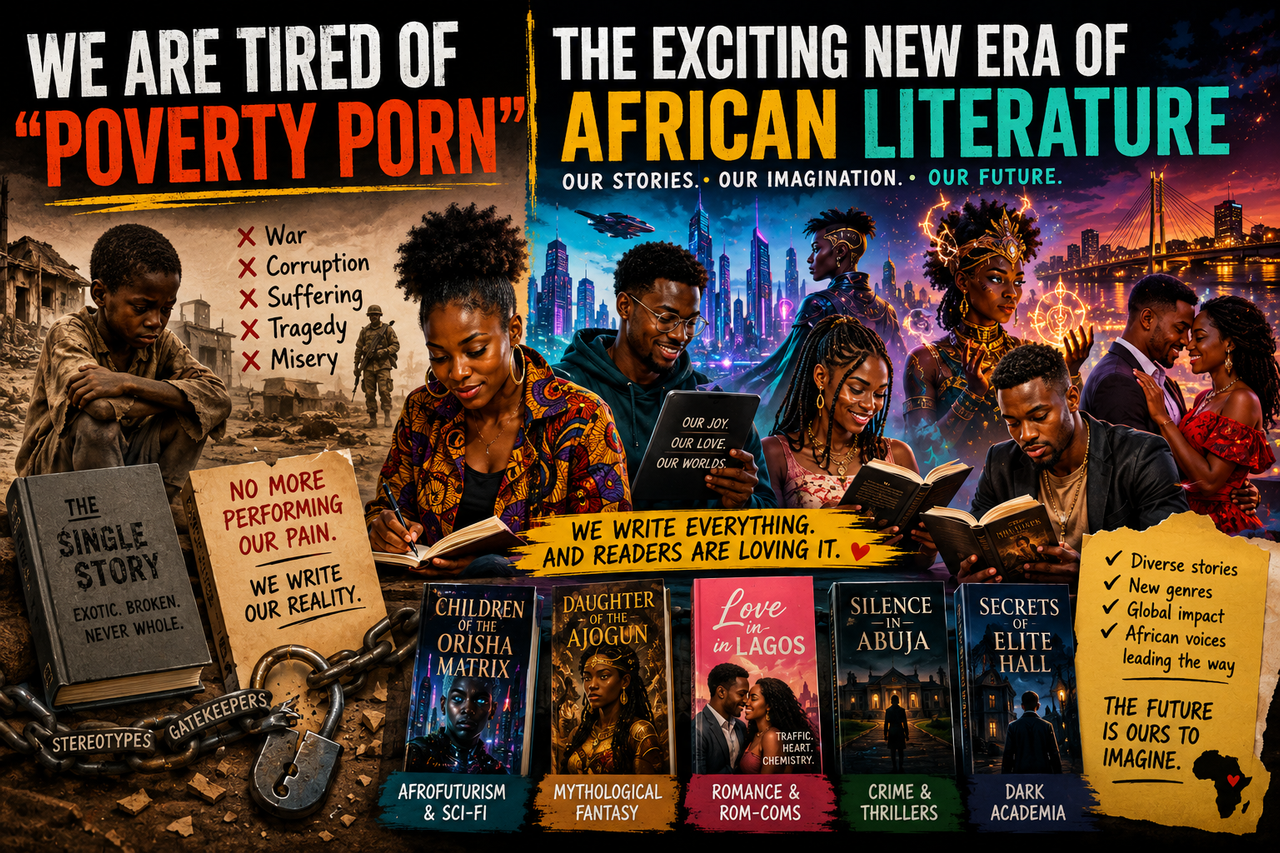
Let us talk about the kind of books that usually win international awards.
For a very long time, if you picked up a critically acclaimed novel written by an African author, you already knew exactly what was going to be inside. There would be a devastating civil war. There would be a corrupt, wicked politician. There would be a helpless child suffering in a dusty village. There would be an extreme cultural tragedy. And by the end of the book, you would be left feeling entirely depressed.
The Western publishing industry absolutely loved these stories. They bought them, translated them into twenty languages, and handed them prestigious global prizes. They loved reading about our trauma because it confirmed the single story they already had about the African continent.
But for those of us actually living here, it became exhausting.
We call it "poverty porn." It is the act of exploiting and exaggerating poverty, trauma, and suffering strictly to gain sympathy or commercial success from a global audience. For decades, if you wanted to be taken seriously as an African writer, you had to perform your pain. If you wrote a book about joy, technology, or simple everyday romance, international publishers would reject your manuscript. They would literally tell you that your story "did not feel authentically African."
Basically, if nobody was starving or dodging bullets in your book, you were not writing African literature.
The Rebellion of the Modern African Writer
Thankfully, that toxic era is finally dying.
In 2026, African literature is experiencing a massive, beautiful rebellion. A new generation of writers has collectively decided that we are no longer going to perform our trauma for the entertainment of a global audience. We have realized that our joy, our imaginations, and our mundane everyday lives are just as valid as our historical struggles.
We live in dynamic, chaotic cities like Lagos, Accra, Nairobi, and Johannesburg. We have tech bros moving crazy startups. We have wicked landlords. We have messy romantic dramas. We have massive pop culture movements and wild internet subcultures.
Why should our books only reflect our pain and never our vibrant reality?
Today, young African writers are breaking down the doors of genre fiction. We are no longer restricting ourselves to heavy historical fiction and political tragedies. We are writing everything, and the reading culture is exploding because of it.
The Rise of African Escapism
Escapism is a fundamental human right. Sometimes you do not want to read a heavy book that makes you cry about the state of the economy. Sometimes you just want to read a book where people fall in love, solve a mystery, or fly spaceships.
Here is what the new era of African literature looks like:
Afrofuturism and Sci-Fi
For years, science fiction was dominated by Western and Asian narratives. If there was a futuristic movie or book, Africa was completely ignored. Now, African writers are building massive sci-fi empires. We are reading stories where African cities are technologically advanced superpowers. We are seeing artificial intelligence, cybernetics, and space exploration blended seamlessly with African culture. We are no longer waiting for the West to imagine the future for us. We are writing ourselves into the future.
Mythological Fantasy
We grew up reading about European dragons, vampires, and wizards attending magical boarding schools. But Africa has some of the richest, most complex mythologies in human history. The new wave of African fantasy authors is building entirely new magic systems based on Yoruba deities, Igbo spirituality, and ancient Hausa legends. They are creating epic fantasy worlds that feel fresh, dangerous, and deeply rooted in our own ancestral history.
Commercial Romance and Rom-Coms
African romance is currently taking over the digital reading space. Writers are giving us spicy, hilarious, and heartwarming stories about modern dating. We are reading about two ambitious professionals falling in love while stuck in Lagos traffic. We are reading about fake dating tropes set at extravagant Nigerian weddings. These books are light, funny, and incredibly relatable. They prove that Africans deserve soft, beautiful love stories too.
Crime and Dark Academia
We are finally getting gripping murder mysteries and psychological thrillers set in our own backyard. Imagine a high stakes whodunit set in a wealthy estate in Abuja, or a dark secret uncovered in an elite private university in Ghana. These are the fast paced, page turning stories that keep readers awake until three in the morning.
Bypassing the Gatekeepers
How did this shift happen so quickly? We stopped asking for permission.
In the past, if a traditional publishing house in New York or London rejected your African sci-fi novel, your book died in your drawer. But the internet changed the balance of power. Digital platforms, self publishing tools, and social media communities like BookTok and Bookstagram allowed African writers to bypass the traditional gatekeepers completely.
Writers started publishing their genre fiction online. And guess what? Readers devoured it. The numbers proved that Africans actually love reading. We just wanted to read stories that entertained us. We wanted to see ourselves as the heroes, the lovers, the detectives, and the space explorers.
The African Experience is Not a Monolith
This does not mean that historical fiction or books about our political struggles are no longer important. Those stories will always be necessary. We must document our history and critique our societies.
But trauma is not our only export. The African experience is not a monolith.
If you are a writer sitting on a manuscript right now, do not let anyone tell you what an "authentic" African story should look like. If you want to write a silly romantic comedy about a baker in Port Harcourt, write it. If you want to write a terrifying horror story set in a local boarding school, write it.
Your imagination does not need a visa to be valid. The world is finally ready to read the full, unfiltered spectrum of African creativity.
💬 Join the Conversation (0 Comments)
Join the discussion!
Sign in to post, like, and reply with a verified profile, or comment as a guest.
Or, comment as a Guest User (No likes/replies)Leave a Comment As