Let us talk about the graveyard of uncompleted stories sitting in your Google Docs right now.
You know the routine. You get a sudden burst of inspiration for a brilliant story, a compelling blog post, or a novel. You open your laptop, stare at the blinking cursor, and type out your first paragraph. You feel like a genius for exactly two minutes.
Then, you read it back.
Suddenly, you realize the opening sentence is not catchy enough. The dialogue sounds a bit rigid. You highlight the entire paragraph and hit backspace. You try again. Ten minutes later, you delete it again. After an hour of fighting with your own brain, you close the laptop, sigh heavily, and decide that you are just not inspired today.
You do this every single week. This is exactly why you have had "Writer" or "Work in Progress" in your social media bio for three years, but you have not actually published a single piece of work.
You do not have writer's block. You have a severe case of premature editing. And if you want to actually finish a project in 2026, you need to understand why trying to write perfectly on the first try is the fastest way to destroy your creativity.
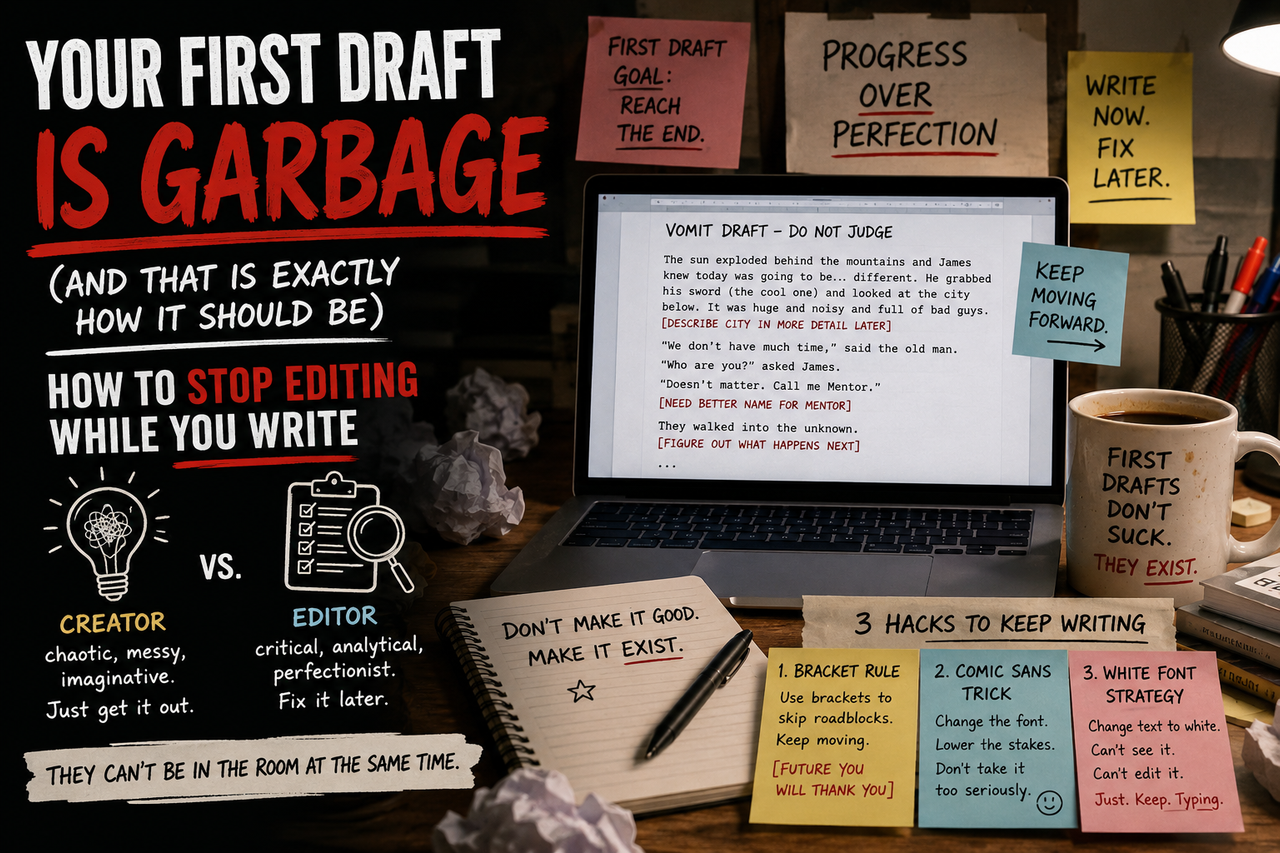
The Creator vs. The Editor
Your brain has two completely different modes when it comes to writing. You have the Creator and you have the Editor.
The Creator is chaotic, messy, and wildly imaginative. The Creator does not care about grammar, punctuation, or whether a sentence makes perfect sense. The Creator just wants to get the idea out of your head and onto the page.
The Editor, on the other hand, is analytical, critical, and obsessed with perfection. The Editor is the one who points out that you used the word "very" three times in one paragraph. The Editor is the one who tells you your character's motivation is weak.
Both of these modes are incredibly important for a writer. But here is the golden rule: they cannot be in the room at the same time.
When you try to write and edit simultaneously, you are forcing the Creator and the Editor to fight for the steering wheel. You are pressing the accelerator and pulling the handbrake at the exact same time. The car will make a lot of noise, smoke will come out of the engine, but you will not move a single inch forward.
You have to fire your Editor during the first draft.
The Myth of the Perfect First Draft
There is a massive misconception among beginner writers that successful authors simply sit down, drink a cup of coffee, and type out a masterpiece from start to finish. We look at a published book and assume the words came out of the author's brain looking exactly like that.
That is an absolute lie.
Behind every beautiful, poetic paragraph you have ever read is a first draft that looked like it was written by a confused toddler. Famous authors do not write perfect first drafts. They just understand that the first draft is not meant to be good. It is only meant to exist.
You cannot build a sandcastle if you do not have any sand. The first draft is simply you dumping a massive pile of wet, messy sand into the sandbox. It does not look like a castle yet. But once the sand is there, you can shape it, carve it, and mold it into something beautiful.
If you stare at an empty sandbox waiting for a perfect castle to magically appear, you will be waiting forever.
Enter the Vomit Draft
In the professional writing world, we call the first attempt the "Vomit Draft." The name is gross, but the concept is highly effective.
Your only goal during a vomit draft is to reach the end of the story. If you forget a character's name halfway through, you do not stop writing to go look for it. You just call them "Guy with the red shirt" and keep moving. If you need to describe a complex futuristic city but you cannot find the right words, you do not sit there for an hour stressing over adjectives. You literally type, "insert cool city description here," and you keep writing.
The objective is forward momentum. You must keep your hands moving across the keyboard. You are telling the story to yourself. You are figuring out what happens next. You are not trying to impress anyone because nobody is ever going to see this draft.
Actionable Hacks to Stop Editing While You Write
If you have been a perfectionist your entire life, shutting off your inner Editor is going to be incredibly difficult. Your brain will literally itch when you see a typo. Here are three hardcore psychological hacks to force yourself to keep moving.
1. The Bracket Rule
This is the ultimate momentum saver. Whenever you hit a roadblock while writing, use square brackets and leave a note for your future self.
Do not know a historical fact? Write: [Research the year the Nigerian civil war ended later]. Cannot think of a funny joke for your character? Write: [Insert witty comeback here].
The moment you leave your writing software to open Google, you have lost the battle. You will end up scrolling through Twitter twenty minutes later. Use brackets to bridge the gaps and keep writing.
2. The Comic Sans Trick
This sounds ridiculous, but it works like magic. Many writers freeze up because the default font on their software looks too formal. It makes the writing feel too serious and permanent.
Change your font to Comic Sans or something equally playful. Because the font looks childish, your brain stops taking the words so seriously. It lowers the stakes. It tricks your inner perfectionist into relaxing because the document no longer looks like a professional manuscript. You can always change the font back to Times New Roman when you are ready to edit.
3. The White Font Strategy
If your urge to edit is completely out of control and you physically cannot stop yourself from deleting sentences, use the nuclear option. Change your text color to white (or black if you are in dark mode).
When your text matches the background, you cannot see what you are typing. You are completely blind. You cannot fix typos because you cannot see them. You just have to trust your fingers and type. You type until you hit your word count goal for the day, and then you change the color back. It is terrifying, but it guarantees that you will produce raw, unfiltered words.
The Magic Happens in the Second Draft
Give yourself permission to write absolute garbage today. Embrace the mess. Let your paragraphs run too long. Let your characters sound ridiculous. Let your plot holes remain wide open.
Just get to the end of the document.
Because once you have a completed, terrible first draft, the hard part is officially over. You can now invite your Editor back into the room. You can take out your digital red pen, cut out the boring parts, fix the dialogue, and polish the sentences until they shine.
Editing a terrible draft is a hundred times easier than staring at a blank page.
Stop trying to be perfect on the first try. Open your laptop right now, lower your standards, and just write.
💬 Join the Conversation (0 Comments)
Join the discussion!
Sign in to post, like, and reply with a verified profile, or comment as a guest.
Or, comment as a Guest User (No likes/replies)Leave a Comment As