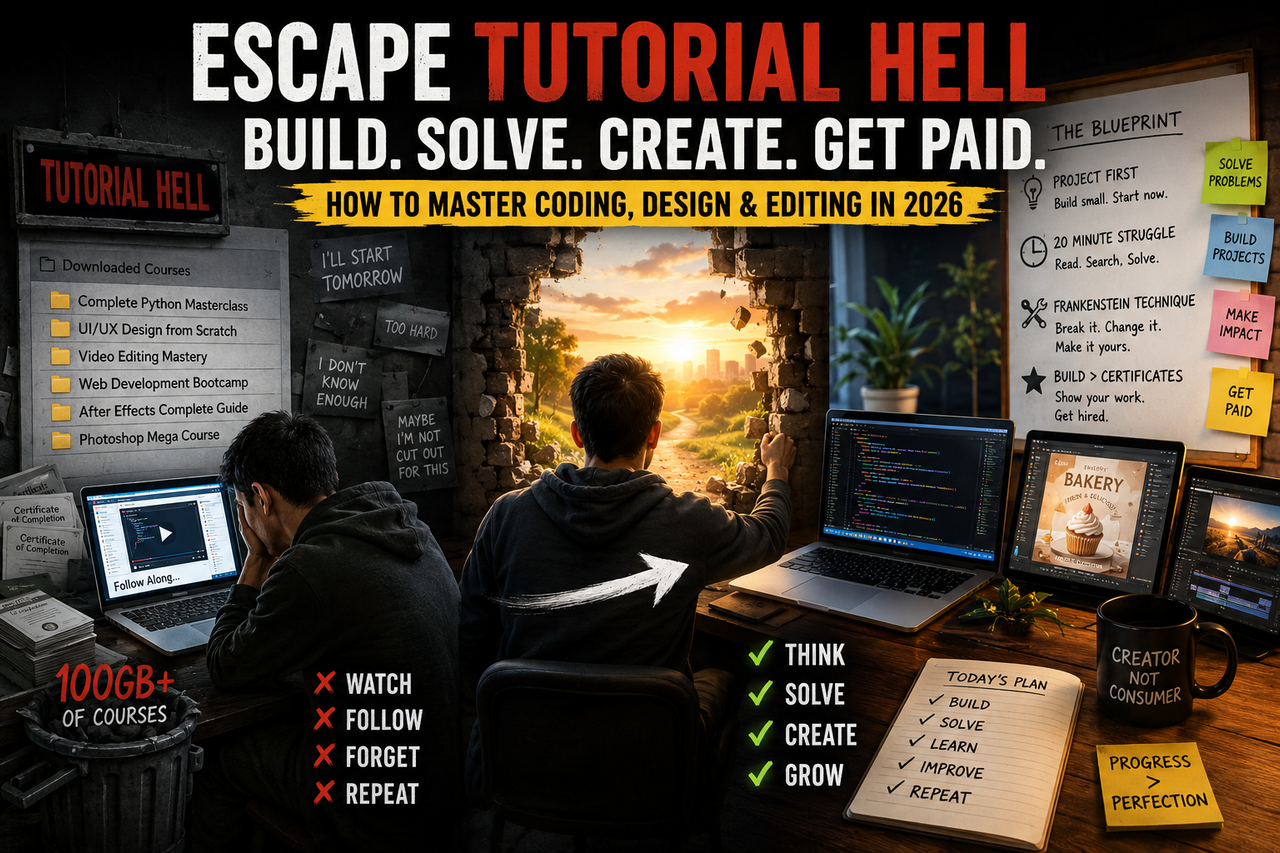
Let us talk about that folder on your laptop.
You know the exact folder I am talking about. The one with 100 gigabytes of downloaded courses you begged someone to send you on Telegram. You have the "Complete Python Masterclass," the "UI/UX Design from Scratch," and a massive video editing course that you swore was going to change your life this year.
You have watched hours of these videos. You sit down, you open your software, and you follow exactly what the instructor on the screen is doing. They type a line of code, you type a line of code. They add a drop shadow to a shape, you add a drop shadow. At the end of the video, you have built a perfect clone of their project. You close your laptop feeling like an absolute genius. You tell your friends you are officially in tech.
But the next day, you open a blank screen to build a project from your own imagination.
Suddenly, your brain completely freezes. You do not know the first step to take. You do not know how to set up the file. You stare at the blank white screen, panic sets in, and you conclude that you just do not know enough yet. So what do you do? You go straight back to YouTube to look for another tutorial.
Welcome to "Tutorial Hell."
This is the exact reason why millions of young people try to learn a high income digital skill and end up quitting after three months. They think tech is too hard. But tech is not the problem. Your learning method is the problem.
The Illusion of Competence
When you follow a tutorial step by step, you are not actually learning how to solve problems. You are just learning how to follow instructions.
The instructor in the video has already done the hardest part of the job. They have already failed, debugged their errors, deleted bad designs, and mapped out the perfect logical path for the project. When you watch the video, you only see the final, polished result.
Because you followed their polished path and your project worked, your brain gets a massive hit of dopamine. You get the illusion of competence. You mistake the instructor's knowledge for your own knowledge.
But real digital skills like coding, graphic design, and video editing are not about memorizing steps. Nobody pays a software engineer to memorize syntax. Nobody pays a designer to know where the pen tool is located. People pay you to solve unique problems. And you can never learn how to solve problems if you constantly have a YouTube instructor holding your hand.
If you genuinely want to master a digital skill and make money from it in 2026, you have to break out of this cycle. Here is the exact blueprint to escape tutorial hell.
Step 1: The Project First Method
The biggest mistake beginners make is trying to learn the entire software or programming language before they build anything. You do not need to read a 500 page book on Python before you write your first script. You do not need to memorize every tool in Adobe Illustrator to design a flyer.
You need to switch to the Project First Method.
Instead of asking, "What tutorial should I watch today?", you need to ask, "What tiny, stupid project can I build today?"
If you are learning web development, do not try to build a massive e-commerce store. Try to build a simple webpage that just displays your favorite quote and changes color when you click a button. If you are learning video editing, do not try to edit a cinematic documentary. Take three random clips on your phone and try to add a text overlay and a transition.
When you start with a project, you will immediately get stuck. And that is exactly what you want. Getting stuck forces you to ask specific questions. You will go to Google and search, "How to change background color in HTML."
When you learn a piece of code or a design trick because you desperately needed it to solve a specific problem in your own project, your brain will never forget it.
Step 2: The 20 Minute Struggle Rule
When you are building on your own and you hit an error, your first instinct will be to run back to a tutorial video to save you. You must fight that urge.
From now on, implement the 20 Minute Rule.
When your code breaks or your design looks terrible, force yourself to sit with the problem for exactly twenty minutes before you ask for help. Read the error message. Most beginners see red text on their screen and immediately panic. Error messages are literally the computer telling you exactly what went wrong and where it happened. Read it.
Google the specific error. Look for the solution on forums like Stack Overflow. Read the official documentation of the software you are using.
Struggling is not a sign that you are not smart enough. Struggling is the actual process of learning. The frustration you feel when something is not working is the feeling of your brain building new neural pathways. If you skip the struggle by running to a tutorial, you are skipping the growth.
Step 3: The Frankenstein Technique
Sometimes, you absolutely have to watch a tutorial to understand a complex concept. That is fine. Tutorials are not evil. The way you consume them is the issue.
When you finish watching a tutorial and building the project, do not just close your laptop. You have to break the project apart to understand how it breathes. This is called the Frankenstein Technique.
Take the project you just built alongside the instructor and completely change three major things about it.
If the instructor built a weather app, change the code so it displays cryptocurrency prices instead. If the instructor designed a dark themed flyer for a nightclub, use the exact same layout but change the colors, fonts, and images to make it look like a bright flyer for a bakery.
When you try to change things, the project will break. Your layout will scatter. Your code will throw errors. And then you will have to dive into the core mechanics to figure out how to fix it. By the time you fix it, the project will no longer belong to the instructor. It will belong to you.
Step 4: Nobody Cares About Your Certificates
We have a massive cultural problem where we value certificates more than actual skills. We love posting our course completion certificates on LinkedIn so people can clap for us.
Here is the brutal truth about the modern digital economy. Clients and employers do not care about your Udemy certificate. They do not care how many 10 hour bootcamps you have completed. They only care about one thing: what can you build?
A developer with zero certificates but a portfolio of three highly functional, creative web applications will get hired ten times faster than a developer with five certificates who has never built anything outside of a tutorial.
Stop hoarding courses. Stop waiting until you feel "ready." You will never feel ready. The only way to become a professional is to start building ugly, broken, terrible projects today, and slowly improve them over time.
Delete the downloaded courses you have been keeping since last year. Open a blank screen. Decide on a tiny problem you want to solve today. Let yourself get frustrated. Let yourself struggle.
That is how you escape tutorial hell. That is how you become a creator.
💬 Join the Conversation (0 Comments)
Join the discussion!
Sign in to post, like, and reply with a verified profile, or comment as a guest.
Or, comment as a Guest User (No likes/replies)Leave a Comment As