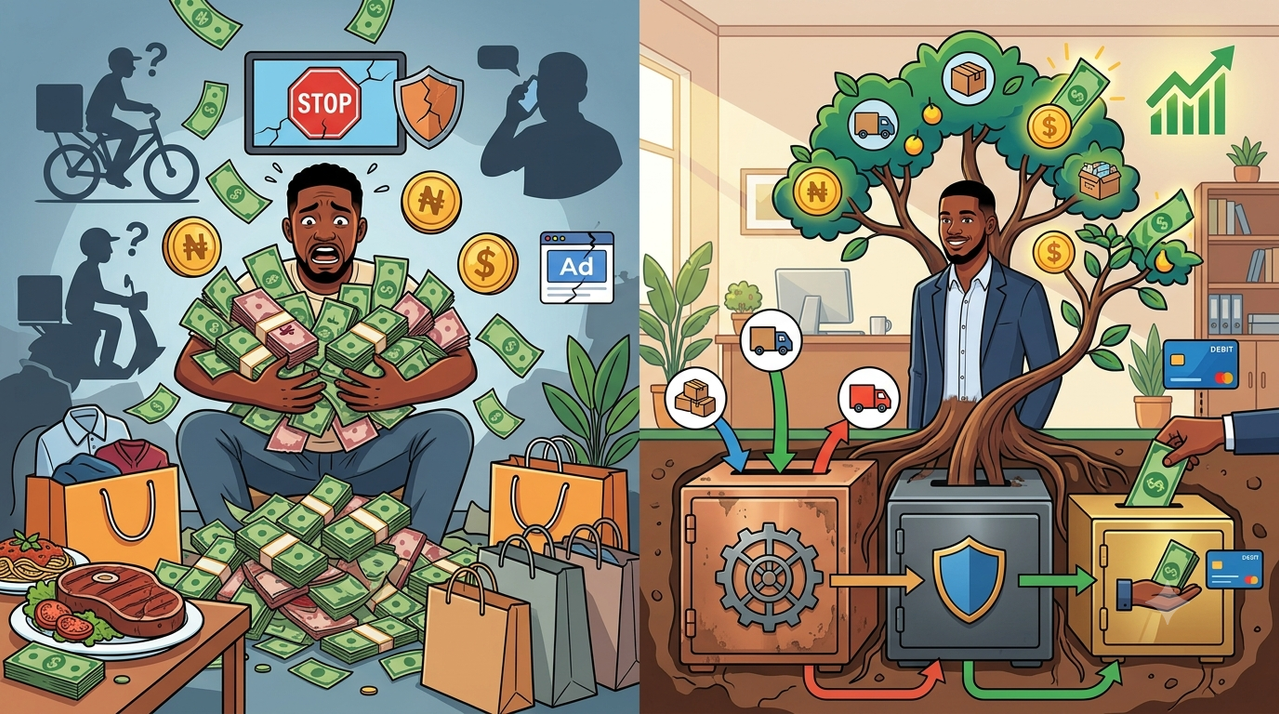
Let us talk about a very specific feeling that every solo entrepreneur knows.
It is Friday afternoon and your phone vibrates in your pocket. You check the screen, and you see a massive bank alert. A client just paid $200 for an order, or a company just settled an invoice for your freelance services.
Instantly, a warm rush of dopamine hits your brain. You feel rich, like a successful business mogul.
So, what do you do?
You open your banking app and transfer forty thousand Naira to your personal account. You buy expensive food, order drinks for the weekend, and buy a nice outfit you saw on Instagram. After all, you worked hard for this money, so you deserve to enjoy the fruits of your labor.
Then, Monday morning arrives.
Suddenly, your supplier calls to tell you that raw material prices have gone up. Your dispatch rider demands payment for weekend deliveries. Your Instagram ad budget runs out and your campaigns stop running.
You open your business account to pay these expenses, and you realize you only have $15 left. You cannot fulfill new orders, or run ads to get new customers.
You end the month completely broke, stressed, and borrowing money from family members just to keep your business alive, despite generating over one million Naira in sales that month.
Welcome to the most dangerous trap in small business: confusing gross revenue with personal income.
If you treat your business bank account like your personal ATM card, your business will die before its second anniversary. It is time to stop playing rich and start managing cash flow like a real CEO.
The Illusion of the Big Credit Alert
The number one reason small businesses fail in their first two years is not lack of sales. It is poor cash flow management.
Many entrepreneurs believe that if they make five hundred thousand Naira in sales this week, they have five hundred thousand Naira to spend, this is a fatal mistake.
Gross revenue is vanity, net profit is sanity. Cash flow is reality.
When a customer pays you $200 for a product, that money does not belong to you.
- A portion of that money belongs to the supplier who sold you the raw materials.
- Another portion belongs to the logistics company handling delivery.
- Another belongs to your internet service provider, your electricity bill, and your advertising budget.
What is left after paying every single business expense is your actual net profit. If you spend the money before paying the expenses, you are literally eating your business seed capital. You are eating the future of your company.
The Crime of Commingled Funds
If you want to build a serious business, you must eliminate the habit of commingling funds immediately.
Commingling means using one personal bank account to receive customer payments, pay suppliers, buy groceries, and pay for personal Netflix subscriptions.
When your personal money and business money live in the exact same account, financial visibility becomes impossible. You will never know if your business is actually making a profit or if you are quietly running at a loss. You will constantly make emotional spending decisions based on an inflated bank balance.
To fix this today, you need to implement the Three Account System.
You do not need to register a massive corporate entity to do this. You can simply open three separate digital bank accounts:
Account 1: The Operating Account (Inflow)
Every single customer payment, client deposit, and sale must enter this account first. All direct business expenses, like inventory, shipping, software tools, and marketing ads, are paid strictly from this account. You never touch this account for personal food, transport, or family emergencies.
Account 2: The Tax & Reserve Account (Buffer)
Every time money enters your Operating Account, automatically move ten to fifteen percent of the net profit into this account. This money is your business emergency shield. It sits there quietly to handle sudden inflation spikes, equipment repairs, and slow sales months.
Account 3: The Personal Salary Account (Outflow)
This is your personal bank account. This is the only account connected to your personal debit card. The only money that should ever enter this account is your fixed, pre-calculated salary.
How to Pay Yourself a Real Salary
One of the hardest questions for solo entrepreneurs is: "How much should I pay myself?"
Amateurs pay themselves whatever is left over at the end of the week. Sometimes they take fifty thousand, sometimes they take two hundred thousand. This inconsistency creates chaotic personal finances and ruins business planning.
Professionals set a fixed salary based on real baseline living costs.
Calculate the minimum amount of money you need to survive every month: your rent contribution, basic food, transport, and essential personal bills. Let us say that number is eighty thousand Naira.
That eighty thousand Naira is your official monthly salary.
On a specific date every month (for example, the 28th), your business transfers eighty thousand Naira from the Operating Account to your Personal Account. That is all you get.
If your business has a massive month and makes five million Naira, your salary remains eighty thousand Naira. The extra profit stays inside the business account to buy better equipment, hire staff, or build a cash reserve.
You must separate your lifestyle from your business revenue spikes. If your personal lifestyle expands every single time your business has a good week, you will never build real wealth.
Building the 3-Month Runway
The economic terrain is unpredictable. Exchange rates fluctuate, fuel prices spike, and social media algorithms change without warning.
If your business operates from hand to mouth, one bad month can completely destroy everything you built.
Your number one financial goal as a founder is to build a 3-Month Runway.
A runway is the amount of cash your business needs to survive for three months if zero customers buy anything from you. Calculate your monthly operating expenses (ads, software, essential bills). Multiply that number by three.
Keep that cash safely inside your Reserve Account.
When you have a three-month buffer, you stop making desperate business decisions. You stop accepting toxic, low-paying clients because your rent is due tomorrow, and stop panicking during slow sales seasons. You gain the peace of mind to think strategically and focus on long-term growth.
Discipline Creates Freedom
Running a business is not about looking wealthy on social media. It is about building an independent, resilient asset that generates sustainable profit.
Stop treating your business like an emergency loan app. Stop flexing with gross sales numbers when your net profit is zero.
Separate your accounts today. Put yourself on a fixed salary. Protect your cash flow with an iron fist, and watch how quickly your business transforms from a stressful hustle into a scalable institution.
💬 Join the Conversation (0 Comments)
Join the discussion!
Sign in to post, like, and reply with a verified profile, or comment as a guest.
Or, comment as a Guest User (No likes/replies)Leave a Comment As