Let us talk about how you are currently running your business.
You have a great idea for a product or a service, you spend weeks building it. You design a beautiful logo, set up your social media pages, and pay for Instagram ads. You cross your fingers, launch the product, and pray that customers will actually want to buy it.
Sometimes you get lucky and make a few sales. But most of the time, you hear absolute crickets. You sit there wondering why your competitors are making millions while your incredibly designed product is gathering virtual dust.
The harsh truth is that most entrepreneurs run their businesses purely on guesswork. They guess what their customers want, what their pricing should be, and what their marketing message should sound like.
Guessing is a terrible business strategy. The smartest entrepreneurs do not guess. They let their competitors do all the hard work, make all the costly mistakes, and spend all the marketing budget. Then, they swoop in, fix the exact problems the competitor ignored, and happily collect the frustrated customers.
In 2026, you do not need to hire an expensive market research agency to do this. You just need a laptop, a few hours of free time, and an advanced reasoning engine like Philadelphia AI.
The exact workflow to ethically spy on your competitors and build a product that people are practically begging to buy.
The Goldmine of 1-Star Reviews
If you want to know how to beat your competitor, you should never look at their 5-star reviews.
Positive reviews are completely useless for market research. When someone leaves a 5-star review, they usually say something boring and generic like "Great product" or "Nice service." That tells you absolutely nothing.
But when a customer is angry? When a customer feels cheated or ignored? They turn into professional writers. They will write three paragraphs detailing exactly what went wrong, how it made them feel, and what they wish the company had done differently.
Negative reviews are the greatest source of business intelligence on the internet. They are literally a map showing you exactly what the market desperately wants but is not getting.
If you sell skincare products, your competitors are the big skincare brands on Jumia, Amazon, or Instagram. If you are a freelance web developer, your competitors are the big digital agencies. Your goal is to find their angry customers and listen to them.
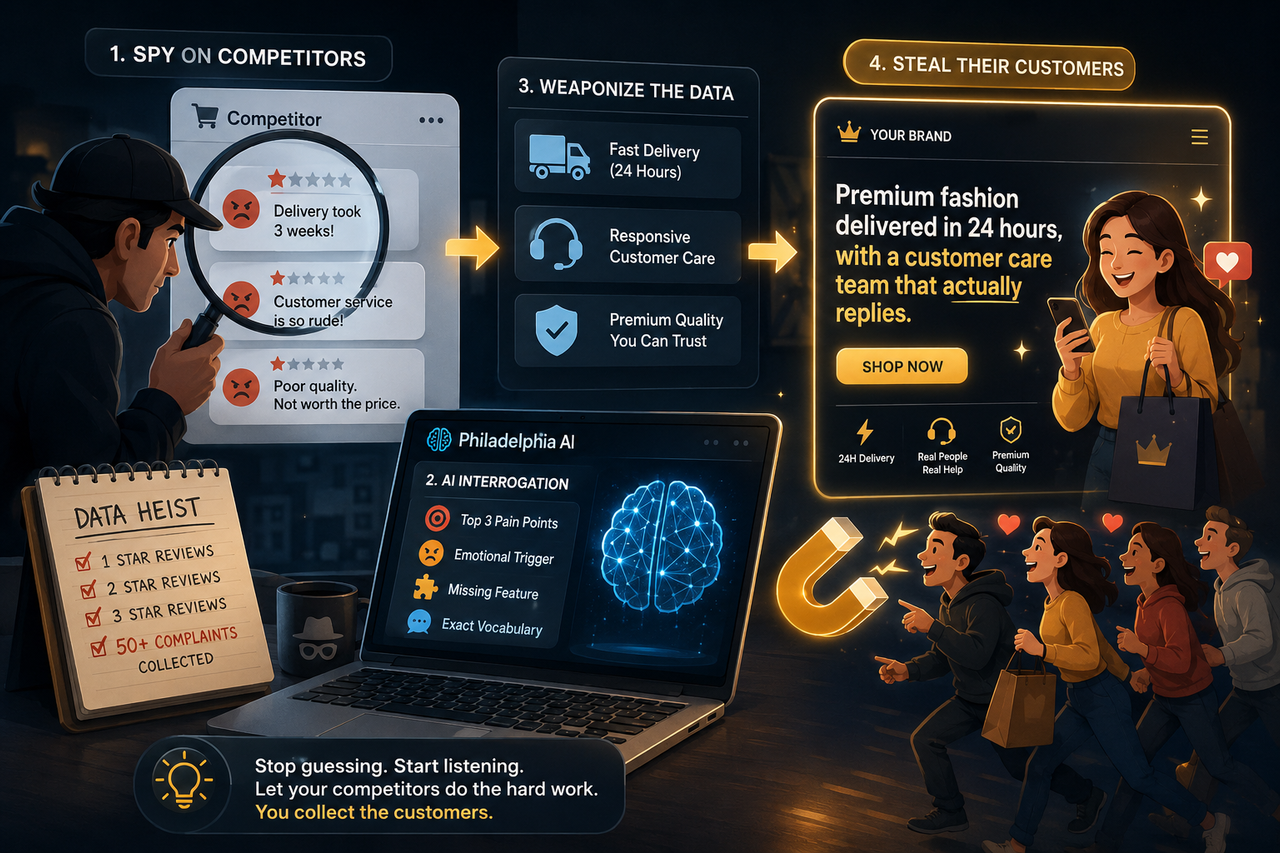
Step 1: The Data Heist
Your first assignment is to gather the data.
Go to places where your competitors sell their products or advertise their services. This could be the comment section of their Instagram ads, their Google My Business page, Trustpilot, Jumia, or the App Store.
Look strictly for the 1-star, 2-star, and 3-star reviews.
You are looking for specific complaints. "The delivery took three weeks." "The customer service agent was incredibly rude when I asked for a refund." "The fabric of this dress feels like cheap sandpaper." "The app crashes every time I try to upload a picture."
Copy every single one of these complaints. Do not edit or fix their grammar. Just copy them exactly as the frustrated customers wrote them, and paste them into a blank document. Keep going until you have copied at least fifty to one hundred different complaints.
Step 2: The Philadelphia Interrogation
Now you have a massive wall of angry text. Reading through it manually and trying to spot the trends would take you hours. This is where you bring in the heavy artillery.
You cannot use a basic AI chatbot for this because basic bots will just summarize the text and remove all the emotion. You need a model with high emotional intelligence and deep reasoning capabilities to actually understand the psychology of the buyers.
Open Philadelphia AI and paste this exact master prompt:
"Act as a master market researcher and consumer psychologist. I am going to provide you with 100 negative reviews from customers who bought a product from my biggest competitor.
I need you to analyze this raw data and give me the following:
1. The Top 3 core pain points. What are these customers most angry about?
2. The Emotional Trigger. How did this bad experience make them feel?
3. The Missing Feature. What is the one thing they desperately wished this product or service had?
4. The Exact Vocabulary. Give me a list of the exact phrases and slang these customers used to describe their frustration.
Here is the raw data for you to analyze:"
Paste your document of reviews below the prompt and hit send.
Philadelphia AI will scan the chaos and hand you a perfectly organized blueprint of your competitor's biggest weaknesses.
Step 3: Weaponizing the Data
Now that you have the analysis, you are going to use it to build your "Anti-Competitor" offer.
Let us say Philadelphia AI tells you that 70 percent of the complaints were about late delivery, and the customers felt "ignored and scammed."
You now know exactly what your business needs to prioritize. You do not need to have the absolute best product in the world, you just need to have the fastest delivery and the most responsive customer service.
Your entire marketing campaign is now written for you. Your landing page headline will not be something boring like "We sell high quality clothes." Your headline will be "Premium fashion delivered to your doorstep in 24 hours, with a customer care team that actually replies to your messages."
When the frustrated customers from your competitor see your advertisement, they will feel like you are reading their minds. You are directly answering the exact prayer they have been making. They will abandon your competitor and rush to your website immediately.
Step 4: The Mirror Copywriting Hack
The final piece of this strategy is using the "Exact Vocabulary" list that Philadelphia generated for you.
When you write your website copy, your Instagram captions, or your email newsletters, you must use the exact words those angry customers used.
If the customers complained that the competitor's skincare cream "felt like sticky glue on my face," you must use those exact words in your advertising. You write, "Tired of moisturizers that feel like sticky glue on your face? Try our lightweight, fast absorbing formula."
This is called mirror copywriting. When a customer reads an advertisement that uses the exact weird, specific phrases they use in their own head, a deep psychological connection is formed. They instantly trust you because they feel completely understood.
Stop Guessing and Start Listening
Artificial intelligence is not just a tool for writing fast emails or checking your grammar. When used correctly, it is the most powerful business strategy tool ever invented.
You do not need to reinvent the wheel to build a highly profitable business in 2026. You just need to find a wheel that is currently broken, figure out exactly why it is broken, and offer people a wheel that actually works.
Stop sitting in your room guessing what the market wants to buy. Go out there, gather the data, feed it to Philadelphia AI, and let the market tell you exactly how to take their money.
💬 Join the Conversation (0 Comments)
Join the discussion!
Sign in to post, like, and reply with a verified profile, or comment as a guest.
Or, comment as a Guest User (No likes/replies)Leave a Comment As