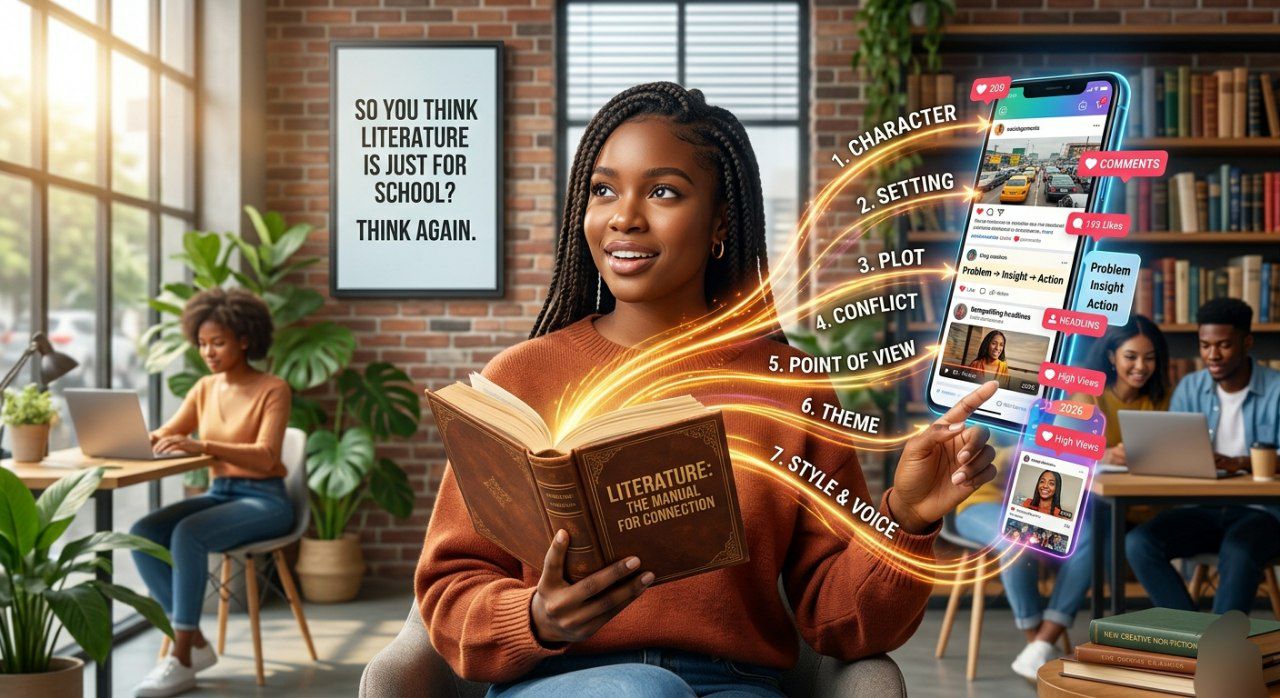
Let's be honest. When someone says "literature," your brain immediately goes back to that secondary school classroom where you had to read a novel you didn't choose, answer comprehension questions you didn't care about, and write an essay on themes you barely understood.
Same.
But Literature was never just about books. It was about people. Stories. The invisible structure underneath every piece of writing that makes someone laugh, cry, or in 2026, stop their scroll.
If you write captions, blog posts, product descriptions, YouTube scripts, TikTok hooks, or even long WhatsApp messages trying to convince your group chat to show up, congratulations. You are already doing literature. You're just doing it without the manual.
This article is the manual.
What Literature Actually Is (Outside the Exam Hall)
Literature is any creative use of language to tell a story, express an idea, or make someone feel something.
That's it.
It doesn't have to be a 500-page novel or a bibliography. It doesn't have to be written by someone who went to Oxford and owns a turtleneck. A well-crafted Instagram caption that made you stop and read three times? That's literature. A product launch email that felt like a story and ended with you clicking buy? Also literature. A comedian's two-minute skit that somehow made you cry at the end? Absolutely literature.
The genres are wide. Prose, poetry, drama, creative nonfiction, but what all of them share is a deliberate use of story elements to create an effect on the reader.
And those story elements? They work just as hard in your blog post as they do in Things Fall Apart.
The 7 Elements of Literature (Your Creator's Toolkit)
Think of these as the ingredients. Great writers and great content creators, know what each one does and use them on purpose.
1. Character
Every story needs someone the reader can follow, root for, or love to hate. In fiction, that's your protagonist. In your content? That's your audience, or you.
When your brand has a personality, when your captions use you and speak directly to a reader's real situation, when your blog post feels like it was written for one specific person, you're using character. The moment your audience sees themselves in your writing, they stay.
2. Setting
Setting is the world the story lives in. For creators, setting is context, the world your audience is navigating. Lagos traffic at 7am. The 3am side hustle grind. The fresh graduate trying to figure out their first job. The small business owner fighting to get their first 1,000 followers.
When you set the scene, when your writing acknowledges the world your reader actually lives in, it creates instant relatability. That's setting doing its job.
3. Plot
Plot is the movement. Something starts, happens, or changes.
Your content should always have plot, even a short one. A beginning that hooks, a middle that delivers, an end that satisfies or challenges. "Here's the problem → here's the insight → here's what you can do." That's a plot arc in a blog post. "I used to struggle with X. Then I discovered Y. Now I do Z." That's a plot arc in a caption.
No movement = no reason to keep reading.
4. Conflict
This is the engine of every good story. No conflict, no tension.
No tension, no reason to care.
In content, conflict looks like: "Everyone says you need 10,000 followers before you make money. That's a lie, and here's proof." Or: "You've been told to post consistently, but nobody told you what happens when consistency without strategy just burns you out."
Conflict is what makes your headline impossible to ignore. It introduces a problem that demands resolution, and your article, video, or caption is that resolution.
5. Point of View
Point of view is simply: whose eyes are we seeing this through?
In content creation, this is your voice and perspective. The angle that is uniquely yours. Two people can write about "how to start a blog" one writes it like a formal guide, the other writes it like a conversation with a friend who's already been through it and is saving you the stress. Same topic. Completely different experience.
Your point of view is the thing that makes people come back to you specifically and not just search for the topic on Google.
6. Theme
Theme is the big idea underneath the story. What is this really about?
On the surface, your article might be about literature. But the theme might be: knowledge you were given for free in school was actually valuable, you just weren't shown how to apply it. That's a theme. It makes your article about more than a topic. It makes it about an idea that your reader can carry forward.
Every piece of content you write should have a theme. It doesn't need to be stated outright, but it should be felt.
7. Style and Voice
This is how you write, not just what you write about. Your word choice, sentence rhythm, how much humour you use, how formal or casual you are.
Style is what makes someone read your content and know it's you without seeing your name. It's what makes Elvion feel different from every other blog. And in a world where AI can generate a thousand generic articles a second, your style is the one thing a machine cannot replicate without your input.
Guard it, develop it, use it deliberately.
The creators, writers, and brands that consistently pull audiences, they're not always the smartest or the most qualified. They're the ones who understand that we humans are wired for story, and we build stories into everything we put out.
Literature gave you the blueprint. You just need to pick it up.
Your Mini Practice: Write Your Story in 150 Words
Take your brand, side hustle, blog, or content page and write a 150-word story about it using this structure:
- Character: Who are you, and who is your reader?
- Setting: What world are you both living in right now?
- Conflict: What problem does your reader face that brought them to you?
- Plot: What journey do you take them on?
- Theme: What idea do you want them to carry away?
Don't make it perfect, make it honest. Then read it back and ask: if I turned this into a blog post, a caption, or a video script, would someone stop and actually read it?
If the answer is yes, you've just written your content strategy in 150 words.
And if you want help refining it, grammatically, structurally or testing how it sounds in a different style or format, that's exactly what tools like Philadelphia AI exist for.
Literature was never just for school. It was always yours to use.
Loading comments...