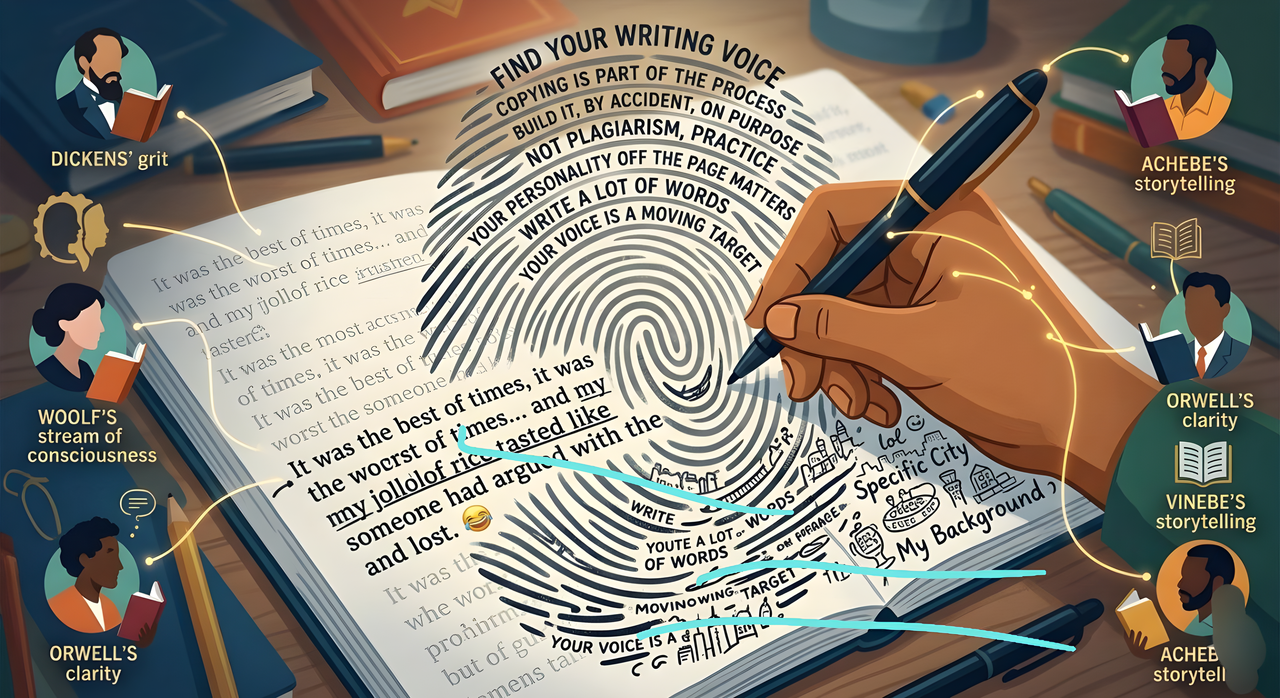
Every writing advice video keeps telling you to do one thing. "Find your voice." Simple sentence, zero explanation.
You hear it so often it starts sounding like a moral instruction. Like there is something wrong with you if you do not have a mysterious, fully formed "voice" yet, sitting somewhere in your chest, just waiting to jump out.
You do not find your writing voice by sitting around waiting for it to appear. You build it, by accident, on purpose, through a lot of imitation, repetition, and small, shameless thefts from writers you love.
Yes. Copying is part of the process.
Let us talk about it properly.
What people think "Voice" means (and what it actually is)
When most people say "writing voice" they make it sound magical and vague.
They talk about it like it is a personality that lives inside your sentences. Something mystical, that arrives one morning when you finally become a real writer.
But your voice is much simpler than that.
It is what happens when your taste, your thoughts, your rhythms, your sense of humour, your background, and your favourite influences all collide on the page in a way that feels natural to you.
Your voice is not a style you pick off a shelf like a jacket.
It is a fingerprint that emerges over time, from the choices you make over and over without noticing. The words you reach for when you are tired and not trying to impress anyone.
The way you naturally tell stories to your friends. The kinds of details you notice first when something happens.
That is voice.
You do not discover it in a single moment, you grow into it.
The lie that stops most writers before they even begin
"If you copy other writers, you will never develop your own voice."
So you sit there staring at a blank page, desperately trying to produce something that feels original, untouched, pure.
Meanwhile every writer you admire started their career doing the exact thing you are afraid of.
They imitated.
Musicians, painters, photographers, all do it. They study other people's work closely and try to recreate what they love about it. Not to steal it forever, but to learn, by hand, what makes it work.
You are not special enough to skip that stage.
If you are still at the beginning of your writing journey, trying to avoid sounding like anyone else is like trying to learn piano without ever touching a song that already exists.
You are not protecting your voice, you are delaying it.
Copying is a training exercise, not a personality
There is a difference between plagiarism and practice.
Plagiarism is passing off someone else's work as your own. That is theft, do not do that.
Practice is studying how someone else wrote something, then using that as a reference to train your own brain and your own hands.
The goal is not to release work that sounds like your favourite writer. The goal is to understand how they did what they did so that you can make your own choices on purpose.
Think of it like this.
If you are learning to draw, your instructor might ask you to copy a famous painting stroke for stroke. Not to sell it, nor put your name on it. But to feel, physically, how that artist used line, shadow, and colour. Writing is the same.
You can pick a passage from a writer you love and:
- Rewrite it in your own words while keeping the same structure.
- Change the topic but copy the sentence rhythm.
- Take their scene and rewrite it from a different character's point of view.
You are not stealing their voice, you are borrowing their scaffolding.
A simple 7 day voice stealing exercise
If your writing feels flat or you feel like you do not have a voice yet, do this for one week.
Day 1: Pick a short passage (200 to 400 words) from a writer you love. It could be a novel, a blog, an essay, a newsletter.
Type it out by hand, not copy and paste. Your fingers need to feel the decisions in the sentences.
Then, on a fresh page, rewrite that same passage in your own words but with the same structure and pacing.
Day 2: Take a blog post or article you love. Outline the way it moves.
Intro, hook, first point, story; second point, example, close.
Write your own piece on a completely different topic, using the same skeleton.
Day 3: Take a dialogue heavy scene from a book, script, or fan fiction you enjoy. Rewrite that conversation between two completely different characters in a different setting but keep the rhythm.
Short lines, long lines, interruptions. Where do they pause, joke, and where is the silence.
Day 4: Pick a writer who is the complete opposite of you.
If you love poetic, flowery language, pick someone blunt and minimal.
If you love minimalism, pick someone dramatic and lyrical.
Imitate them for 300 words. It will feel wrong, that is the point.
Day 5: Take a piece you wrote months ago. Rewrite it as if your favourite writer wrote it.
Do not just edit, transform it, take risks you would normally avoid.
Day 6: Free write for 20 minutes without any reference.
No copying or outline. Just you, a timer, and your thoughts.
Day 7: Read everything you wrote this week, out loud.
Ask yourself.
In which pieces did you feel most like yourself, even when you were copying someone else.
Which experiments made you uncomfortable in a good way.
That awareness is your voice starting to wake up.
Why your personality off the page matters more than you think
You can copy structure, rhythm, or techniques.
You cannot copy the one thing nobody else has.
Your life.
The way you grew up. The languages you move between in your head, the TV shows that raised you. The music your parents played in the background. The way your friends talk. The things you find funny that other people might not.
Most writers try to sound like a writer.
So they sandpaper all their personal quirks away.
They remove the slang they actually use.
They avoid mentioning their specific city, culture, or background because they are scared it will not be relatable.
They slowly erase the exact details that would have made their writing unforgettable.
Your voice lives in those details.
It is the difference between:
"He was angry."
And.
"He replied with a "lol" and stopped talking to me for three days."
or
"The food was bad."
And.
"The jollof tasted like someone had argued with the pot and lost."
Same emotion, completely different flavour.
You do not invent this on the page. You notice it in your life, then carry it over.
The trap of sounding "Smart"
A lot of writers lose their voice chasing one thing.
They want to sound intelligent.
So they start using big words they do not use in real life. They write long sentences that twist themselves into knots. They hide simple truths behind complicated phrasing.
The result.
The writing might look impressive for three lines, but it is exhausting to read.
Voice is not about sounding smart. It is about being clear and specific in a way that only you can be.
If you can say something in five simple words and you choose twenty, your voice is not deep. It is distant.
One easy test.
Write a paragraph the way you normally would, then ask yourself.
Would I say this out loud to a real person without feeling weird?
If the answer is no, you are performing, not speaking.
Your voice shows up when you stop pretending to be a writer and start talking on the page the way you would talk if the person you care about most was sitting across from you.
How to know if you are getting closer to your voice
You are not going to wake up one day and think "Yes, this is it, I have found my voice."
But you will notice small changes.
You will start to recognise yourself in your own work.
You will find yourself using the same kinds of metaphors, jokes, or sentence shapes without thinking.
People who read your stuff more than once will say, "This sounds like you."
You will feel less pressure to impress and more desire to tell the truth.
You will notice that it becomes harder and harder to imitate other people completely, because your own instincts keep pushing through.
These are all signs that your voice is forming.
Not because you waited to find it.
But because you have written enough that your patterns have had time to show up.
What to do when you hate your voice
There will be a phase, maybe more than once, where you look at your writing and think one clear thought.
"This is trash."
You will see every flaw at once.
Too simple, childish, or too dramatic. Too plain, too much like that other writer. Not enough like that other writer.
This is normal.
Your taste will always evolve faster than your skill.
You will know what good writing sounds like long before you can consistently produce it yourself.
The mistake is thinking that hating your voice means you should stop.
In reality, it means your taste is working. You know you can do better.
That gap between where you are and where you want to be can only be crossed by writing more.
Not by waiting. Not by reading more quotes about creativity on Instagram. Not by shopping for the perfect notebook.
By writing more.
Your voice is a moving target. It will sound different in six months. It will sound different in three years.
The only way it improves is if you let it be imperfect in public for a while.
A practical way to use multiple influences without becoming a copy
If you only imitate one writer, you will sound like their discounted version.
If you study many writers, you become a mix nobody else can duplicate.
Think of three writers or creators whose work you love.
Maybe one is a novelist, blogger, screenwriter, comedian; or a songwriter.
Ask yourself three questions about each.
What do they do with language that I love?
How do they structure their ideas or stories?
What do they do with emotion and humour that feels natural to me?
For one month, focus each week on a different influence.
Week 1: borrow their sentence rhythm.
Week 2: borrow their way of structuring ideas.
Week 3: borrow their way of handling emotion and humour.
Week 4: write without looking at any of them.
With this, you are creating a playlist. Your voice is what happens when all those tracks blend.
The only rule you actually need
There is one rule that sits under all the techniques.
Write a lot of words that you are allowed to throw away. Most people try to protect themselves from embarrassment by writing very little and editing every sentence like it is a tattoo.
They want their early drafts to look like late drafts. They want their practice pages to already sound like something that belongs in a book.
It does not work like that.
You need thousands of careless, experimental, average sentences to arrive at one sentence that feels like you.
The work you hate right now is not a sign that you are talentless.
It is compost.
You are piling it up so something useful can grow on top of it later. Let it be messy.
You do not have to show all of it to the world. You just have to write it.
The part you do show will be stronger because you did. The invitation at the end.
If you feel like you do not have a writing voice yet, you are not behind, you are just early.
Every writer you admire had a season where their work sounded like a cheap imitation of someone else.
They just did not stop there.
They imitated, experimented, and kept going long enough for their own patterns to take over.
You can do the same.
Pick one writer you love. Steal something small from them on purpose this week.
Then sit down and write something only you could write.
Your voice is already trying to speak, the only question is how often you will give it a chance.
Loading comments...